





Table des matières
- Why Is My Fungal Nail Infection Not Going Away?
- 7 Reasons Your Fungal Nail Treatment May Not Be Working
- How Long Does Fungal Nail Treatment Take to Work?
- What Are the Signs That Fungal Nail Treatment Is Working?
- What Can You Do at Home to Support Fungal Nail Care?
- When Should You Speak to a GP or Pharmacist?
- Can You Treat a Fungal Nail Infection at Home?
- How to Choose an At-Home Fungal Nail Treatment
- Plus de questions fréquentes
If you have been treating a fungal nail infection but your nail still looks thick, discoloured or brittle, it is understandable to wonder whether the treatment is working. The important point is that fungal nail treatment usually takes time, and visible nail changes can remain even after the fungal infection starts to improve.
Nails grow slowly, particularly toenails. Depending on the treatment, the extent of the infection and your individual circumstances, it can take several months before you notice clear changes. NHS guidance notes that antifungal nail medicines may need to be used for 6 to 12 months, with improvement sometimes taking several months to become visible.
So, if you are asking “why won’t my fungal nail infection go away”, the answer may not be that your treatment has failed. It may be that the infection and the damaged nail simply need more time, or that another factor is affecting your progress.
 1. Why Is My Fungal Nail Infection Not Going Away?
 1. Why Is My Fungal Nail Infection Not Going Away?
In many cases, a fungal nail infection does not disappear quickly because both the infection and the damaged nail take time to improve. A treatment may start addressing the fungus before you can see a dramatic difference in the appearance of the nail.
There are two important things to understand: the treatment needs enough time to work, and the damaged part of the nail needs to grow out.
Fungal nails can take months to improve
If you have recently started treatment, a lack of obvious change does not necessarily mean it is ineffective. NHS guidance states that antifungal nail medicines may need to be used for 6 to 12 months, depending on the medicine, and that it may take several months before you start to see an improvement.
This is very different from treating a minor skin irritation, where improvement may be noticeable within days. A fungal nail infection affects the nail and sometimes the tissue beneath it, while the nail itself grows slowly.
This is why someone searching “why is my toenail fungus not going away” after only a few weeks may simply be expecting visible results too soon. The right approach is to follow the directions for the treatment you are using and assess progress over time rather than judging the result from the appearance of the nail after only a short period.
The damaged nail has to grow out
Even when the fungal infection is improving, the part of the nail that was already damaged does not instantly return to normal. The nail needs to grow from the base towards the tip, gradually replacing the affected portion. NHS guidance uses the appearance of healthy nail growing back from the base as an important sign that the infection has cleared.
The American Academy of Dermatology also explains that nails grow slowly and that nail changes can remain visible while the nail grows out. In some cases, a toenail can take a year or longer to grow out fully.
This distinction is important: infection control and nail appearance are not always the same thing.
2. 7 Reasons Your Fungal Nail Treatment May Not Be Working
If your fungal nail treatment not working is a concern, there are several possible explanations. Some relate to treatment duration and consistency, while others involve the extent of the infection or whether the nail problem was fungal in the first place.
(1) You stopped treatment too early
Stopping treatment as soon as the nail looks slightly better can make it difficult to achieve the intended result.
Different antifungal nail medicines have different treatment schedules, so there is no universal number of days or weeks that applies to every product. Some are used daily, while others are used weekly. Follow the instructions provided with the specific treatment rather than stopping simply because the nail looks unchanged.
The AAD similarly advises that some topical prescription treatments need to be continued for the prescribed duration, even if symptoms begin to improve.
(2) The infection is more extensive than it appears
The visible part of a damaged nail does not always tell you how extensive the underlying problem is.
Fungal nail infections can affect one nail or several nails, and the nail may become thickened, brittle, discoloured, lifted or crumbly. If a large portion of the nail is affected, the infection may be more difficult to manage with a topical product alone. This is particularly important if the infection has spread to several nails or has not improved despite appropriate treatment.
If your nail condition is extensive or worsening, professional assessment can help determine whether another treatment approach is more appropriate.
(3) Treatment has not been used consistently
Consistency matters when using a topical nail treatment.
If applications are frequently missed, the treatment routine may become less effective or simply take longer to complete. The exact frequency depends on the product, so follow its instructions rather than assuming that more frequent application will produce faster results.
A useful habit is to connect treatment with an existing part of your routine, such as your evening foot-care routine. The goal is not to apply more product than recommended. It is to use the product correctly and consistently for the required period.
(4) The nail is growing slowly
Slow nail growth is one of the biggest reasons fungal nail recovery can feel frustrating.
Toenails generally grow more slowly than fingernails, and the big toenail can take a particularly long time to grow out.
The AAD notes that even after the fungal infection has cleared, visible nail changes may remain until the affected nail grows out. This means that fungal nail treatment progress should not be judged solely by whether the whole nail looks normal.
Instead, look for gradual changes, particularly at the base of the nail where new growth appears.
(5) The nail may not have a fungal infection
Not every thick, yellow or damaged nail is caused by fungus.
Nail trauma, psoriasis and other nail conditions can sometimes look similar to fungal nail infection. The AAD notes that accurate diagnosis is important because other nail conditions can resemble nail fungus, and a healthcare professional may sometimes take a nail sample to confirm the diagnosis.
This is particularly relevant if you have been treating your nail appropriately but see no meaningful improvement.
If you are unsure whether the problem is actually fungal, speak with a pharmacist or GP rather than repeatedly switching between different treatments without knowing the cause.
(6) Reinfection may be happening
A fungal nail infection can return after it has improved.
One possible reason is that fungus affecting the surrounding skin, particularly athlete’s foot, has not been addressed. Warm, damp feet and sweaty footwear can also create conditions that make fungal infections more likely. NHS guidance recommends keeping feet clean and dry, changing socks regularly and treating athlete’s foot promptly.
If you are wondering “why does toenail fungus keep coming back”, it is worth looking beyond the nail itself. Footwear, socks, nail tools and everyday hygiene habits can all form part of a prevention routine.
(7) The infection may need professional assessment
If your treatment has not worked, the infection has become severe or it has spread to other nails, it is sensible to seek professional advice.
The NHS recommends seeing a GP if a fungal nail infection is severe and treatment has not worked, if it has spread to other nails, or if you have diabetes or a weakened immune system. A GP may consider prescription antifungal tablets when pharmacy treatment has not worked. Depending on the situation, a nail sample and blood tests may also be required.
This is an important distinction: persistent nail changes do not automatically mean you need a stronger product. Sometimes you first need to confirm the diagnosis or reassess the treatment approach.
3. How Long Does Fungal Nail Treatment Take to Work?
Fungal nail treatment can take several weeks, or months to show visible improvement, and the complete treatment period depends on the medicine, the affected nail and the extent of the infection.
NHS guidance says antifungal nail medicines may need to be used for 6 to 12 months, while the AAD explains that the nail itself may take much longer to grow out completely.
So, if you are searching “how long does fungal nail treatment take”, there is no single timeline that applies to everyone. Similarly, “how long does toenail fungus take to clear” can have two different meanings:
- How long it takes to control or clear the fungal infection.
- How long it takes for the damaged nail to grow out.
These are not necessarily the same.
For example, prescription oral treatment may be completed in a matter of weeks or months, while the visible nail can take considerably longer to return to a healthy appearance.
For this reason, it is better to focus on gradual improvement rather than expecting the entire nail to look normal within a few weeks.
If you are unsure “when should I see improvement from fungal nail treatment”, check the instructions for the specific product you are using and speak to a pharmacist if you are concerned about your progress.
4. What Are the Signs That Fungal Nail Treatment Is Working?
The clearest sign of improvement is healthy nail beginning to grow from the base, rather than an immediate return to a completely normal-looking nail. This is consistent with NHS guidance, which states that the infection is considered cured when healthy nail is seen growing back at the base.
(1) Healthy nail starts growing from the base
Look closely at the area nearest the cuticle.
If new nail appears clearer, smoother and more normal-looking than the older affected nail, this can be an encouraging sign of fungal nail recovery.
The older discoloured or thickened section may still be visible further along the nail. That does not necessarily mean the treatment has failed.
(2) The affected area gradually moves towards the nail edge
As the nail grows, the previously affected section gradually moves towards the free edge.
This can make progress easier to see over time. Taking a photograph of the nail every few weeks, under similar lighting, can also make gradual changes easier to notice.
Avoid comparing your nail from one day to the next. Nail growth is slow, so daily changes are often too subtle to judge.
(3) The nail becomes less brittle or crumbly over time
A fungal nail may become thickened, brittle, cracked or crumbly.
If these characteristics gradually become less pronounced while healthy nail grows from the base, that may indicate improvement.
However, nail appearance alone cannot confirm that a fungal infection has completely cleared. If you remain uncertain, professional advice can help.
(4) What improvement should not be expected immediately?
You should not expect the entire nail to suddenly become clear after starting treatment.
The affected nail may continue to look discoloured or thick for some time because damaged nail has to grow out. The AAD specifically notes that nail changes can remain visible even after the fungus has cleared.
In other words, fungal nail treatment progress is gradual. Patience and consistent use are often more realistic than looking for dramatic short-term changes.
5. What Can You Do at Home to Support Fungal Nail Care?
Good foot and nail hygiene can help reduce the conditions that allow fungal infections to persist or return, but hygiene alone should not be treated as a replacement for antifungal treatment. NHS guidance recommends keeping feet clean and dry, changing socks daily and avoiding shared towels, shoes and nail tools.
(1) Keep feet clean and dry
Fungi thrive in warm, damp environments.
Wash your feet regularly and dry them carefully, particularly between the toes. If your feet become sweaty during the day, changing into clean, dry socks can help maintain a less favourable environment for fungal growth.
(2) Trim nails carefully
Keep nails reasonably short and trim them carefully rather than picking or tearing them.
Do not aggressively scrape or remove affected nail yourself. The AAD warns that scraping or filing cannot remove all of the fungus because fungal organisms can also be present within the nail and underlying tissue.
(3) Change socks regularly
Fresh socks help reduce moisture around the feet.
If your feet become particularly sweaty, you may need to change socks more frequently. Choose materials and footwear that help keep your feet comfortable and dry.
(4) Choose breathable, well-fitting footwear
Avoid shoes that make your feet excessively hot or sweaty.
NHS guidance recommends shoes that fit well and do not have narrow toes, and advises avoiding footwear that makes your feet hot and sweaty.
(5) Treat athlete’s foot promptly
Athlete’s foot can occur alongside fungal nail infection and can provide a potential source of reinfection.
If you have symptoms of athlete’s foot, such as itchy or peeling skin between the toes, speak to a pharmacist about appropriate treatment.
Treating the surrounding skin is an important part of reducing the chance of fungal problems returning to the nails.
(6) Avoid sharing towels, shoes or nail tools
Do not share towels, shoes, nail clippers or scissors with other people.
NHS guidance specifically recommends avoiding shared towels, shoes and nail tools as part of fungal nail infection prevention.
Clean your own nail tools regularly and keep them separate from other people’s personal-care items.
6. When Should You Speak to a GP or Pharmacist?
A pharmacist is a useful first point of advice for many uncomplicated fungal nail infections, while a GP should assess infections that are severe, spreading or not responding to treatment.
A pharmacist can advise on suitable antifungal nail medicines and how they should be used. This can be particularly helpful if you are unsure whether an over-the-counter option is appropriate for you.
You should speak to a GP if:
- the infection is severe and treatment has not worked;
- the infection has spread to other nails;
- you have diabetes;
- you have a weakened immune system; or
- you are uncertain whether the nail problem is actually caused by a fungal infection.
The NHS also notes that some people may need prescription antifungal tablets when pharmacy treatment has not worked. These medicines are not suitable for everyone and may require medical assessment and monitoring.
If you are pregnant, breastfeeding, under 18, taking other medicines or living with another health condition, ask a pharmacist or GP before starting an antifungal treatment.
7. Can You Treat a Fungal Nail Infection at Home?
Some fungal nail infections can be managed with topical antifungal nail medicines, particularly when the infection is suitable for this type of treatment, but not every nail infection can be treated effectively at home. NHS guidance states that pharmacists may recommend antifungal nail medicine applied directly to the affected nail.
(1) Topical nail treatments
Topical treatments are applied directly to the affected nail.
Depending on the product, they may need to be applied daily or weekly and continued for several months. The exact instructions vary, so always follow the directions supplied with the treatment.
Topical treatment can be convenient for people who prefer an at-home routine, but consistency is important.
The AAD also notes that prescription topical medicines may be used for some cases of nail fungus, particularly when the infection is suitable for topical management.
(2) Oral antifungal medicines
Oral antifungal medicines work throughout the body and may be prescribed when a more intensive treatment approach is appropriate.
They are not simply a stronger version of an over-the-counter nail treatment. Some oral antifungals can interact with other medicines or affect the liver, which is why medical assessment and, in some cases, blood tests are required.
For this reason, oral antifungal treatment should only be used according to professional medical advice.
(3) When professional treatment may be needed
Professional assessment becomes particularly important when the infection is extensive, has spread to several nails, has not responded to appropriate treatment, or when there is uncertainty about the diagnosis.
A healthcare professional may sometimes take a nail sample before prescribing oral treatment because other nail conditions can resemble fungal infection.
The goal is not simply to find a stronger treatment. It is to make sure the underlying nail problem has been correctly identified and managed appropriately.
8. How to Choose an At-Home Fungal Nail Treatment
The most useful at-home fungal nail treatment is one that is designed for nail use, has clear directions and fits a routine you can follow consistently.
Rather than choosing a product because it promises the fastest result, consider how the treatment fits into your everyday routine and whether its ingredients, directions and intended use are clear.
(1) Look for a treatment designed specifically for nails
The nail is different from ordinary skin, so a product intended for athlete’s foot should not automatically be assumed to work for a fungal nail infection.
The AAD specifically notes that non-prescription terbinafine creams intended for skin infections such as athlete’s foot cannot treat the nail because the medicine needs to penetrate the nail to treat nail fungus.
Always check that the product is specifically intended for the nail and follow its instructions.
(2) Check the active ingredients and directions
Look beyond marketing claims.
Check what the product contains, how it should be applied, how often it should be used and how long the recommended course lasts.
If a product contains botanical ingredients, that can be part of the overall formulation, but “natural” does not automatically mean effective or suitable for everyone.
A science-led approach means considering the formulation, intended use, available evidence and instructions together.
(3) Consider the application method
A liquid, solution, lacquer or other topical format may suit different routines.
For example, a precision applicator can make it easier to apply a product directly to the intended nail area without using more product than necessary.
The best format is ultimately one that you can use correctly and consistently.
(4) Choose something you can use consistently
A complicated routine is easier to abandon.
If your chosen treatment requires regular application over several months, consider whether it fits naturally into your daily or weekly habits.
Consistency is especially important because nail treatment is rarely a quick process.
(5) Set realistic expectations
Be cautious about any product that promises to eliminate a fungal nail infection overnight or guarantee a complete cure.
Fungal nail infections commonly require months of treatment, and the nail may take even longer to grow out. A more realistic goal is gradual improvement supported by appropriate treatment, consistent use and good foot and nail care.
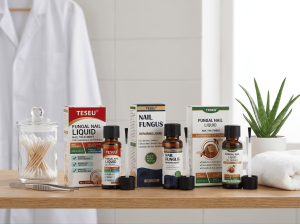
If you are looking for a simple topical option to include in an at-home nail-care routine, you can explore our solution contre les mycoses des ongles for targeted nail care and review its ingredients, directions and intended use before deciding whether it is suitable for you.
9. More FAQs
Q1: Can fungal nail infections go away on their own?
Some fungal nail infections may eventually improve without treatment, but this should not be assumed. Fungal nail infections can persist for a long time and may become more extensive. If your nail is painful, the infection is spreading, or you have diabetes or a weakened immune system, speak to a pharmacist or GP for appropriate advice.
Q2: How long does toenail fungus take to grow out?
A damaged toenail can take many months to grow out completely. The AAD notes that a big toenail may take a year or longer to become clear after treatment because the nail grows slowly. This means the visible appearance of the nail may lag behind improvement in the underlying infection.
Q3: Can I wear nail polish while treating fungal nails?
You should check the instructions for the specific treatment you are using before applying nail polish. Some treatments may require direct access to the nail surface, while others have specific application instructions. The AAD advises people using nail-fungus treatment to ask their dermatologist whether nail polish is appropriate during treatment.
Q4: Can fungal nail infection come back after treatment?
Yes, fungal nail infection can come back after treatment, even after the nail has improved. The AAD notes that recurrence can happen a year or more after clearing. Keeping feet dry, treating athlete’s foot promptly, avoiding shared nail tools and maintaining good footwear hygiene can help reduce the risk of another infection.
Q5: Can fungal nail infection spread to other nails?
Yes, a fungal nail infection can affect more than one nail. If the infection spreads to additional nails, the NHS recommends speaking to a GP. Maintaining good foot hygiene, keeping nails short and avoiding shared towels, shoes and nail tools can help reduce the risk of spreading or recurrence.
Q6: Is a thick yellow nail always a fungal infection?
No. A thick or yellow nail is not automatically a fungal infection. Nail trauma, psoriasis and other nail conditions can produce similar changes. If treatment is not improving the nail or you are unsure about the cause, seek advice from a pharmacist or GP rather than assuming that the problem is fungal.
Q7: When should I stop treating a fungal nail infection?
Do not stop a treatment simply because the nail still looks abnormal after a few weeks. Follow the product instructions or advice from your pharmacist or GP. Because damaged nail needs time to grow out, visible changes can remain for months. If treatment is not working, the infection is spreading or you are concerned about the diagnosis, seek professional advice.
[References & Further Reading]
- NHS: Fungal nail infection
- AAD: Nail fungus diagnosis and treatment
- AAD: Nail fungus causes
- AAD: Nail fungus signs and symptoms
- AAD: Nail fungus FAQs
Disclaimer: This article is for informational purposes only and does not constitute medical advice. Always consult your doctor, dermatologist, or pharmacist before starting any treatment, especially if you have diabetes, circulatory issues, or are unsure about your skin condition.