




Verrucas are common skin growths caused by the human papillomavirus (HPV), often appearing on the soles of the feet where pressure from walking can make them uncomfortable or painful. While many verrucas clear naturally over time, some can be persistent and difficult to remove without the right treatment approach. Discover what verrucas are, how they differ from other common foot conditions, and the most effective ways to get rid of verrucas with safe home treatments.
Table of Contents
- What Is a Verruca?
- Verruca vs Wart: What Is the Difference?
- Can You Treat a Verruca at Home?
- How Does Verruca Treatment Work?
- Verruca Treatment Options Compared
- How to Use Verruca Treatment Liquid Safely?
- How Long Does It Take to Get Rid of Verrucas?
- Painful Verruca Treatment: What to Know?
- How to Help Prevent Verrucas from Spreading
- Choosing a Wart Removal Liquid for At-Home Care
- When Should You See a GP, Pharmacist or Podiatrist?
- Final Thoughts
- More Frequently Asked Questions
 1. What Is a Verruca?
 1. What Is a Verruca?
A verruca (also called “plantar wart“) is a type of wart that develops on the sole of the foot and is caused by the human papillomavirus (HPV). Unlike many common warts, verrucas often grow inward because of pressure from walking, which can make them painful and harder to remove.
Verrucas can spread through close skin contact or contaminated surfaces, particularly when skin is wet or damaged. This is one reason they are often associated with communal changing areas, swimming pools and showers. They are usually harmless, but they can be uncomfortable, frustrating and slow to disappear. NHS guidance notes that warts and verrucas often clear without treatment, although this may take months or even year
2. Verruca vs Wart: What Is the Difference?
The main difference between a verruca and a common wart is their location and growth pattern: verrucas usually appear on the soles of the feet and grow inward due to pressure, while common warts usually grow outward on hands or other areas.
|
Feature |
Verruca |
Common wart |
|
Cause |
HPV virus |
HPV virus |
|
Typical location |
Sole of the foot, heel, ball of the foot or toes |
Hands, fingers, knees and other skin areas |
|
Growth pattern |
May appear flatter or be pushed inward by walking pressure |
Often rougher and more raised |
|
Discomfort |
Can be painful when standing or walking |
Usually less affected by body weight |
|
Visual clues |
May have tiny black dots |
Can be rough and grainy, but black dots are less often noticed |
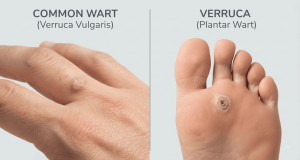
The tiny black dots sometimes seen in a verruca are small clotted blood vessels. They are not “roots” or seeds. The hard skin that can form over a verruca may make it feel like you are walking on a small stone.
3. Can You Treat a Verruca at Home?
Yes, many verrucas can be treated at home, especially with consistent use of proven treatments such as acid-based products.
For many people, verruca treatment at home is a practical first step. UK pharmacies offer over-the-counter options such as treatment paints, gels, liquids, plasters and freezing products. NHS guidance recognises that these pharmacy treatments are available for warts and verrucas.
The most suitable approach depends on the lesion’s location, size, discomfort level, your medical history and how consistently you can follow the instructions.
Common at-home options include:
- Acid-based treatments, which gradually remove thickened infected skin
- Treatment liquids or gels designed for targeted application
- Medicated plasters, which may be useful for some foot locations
- Over-the-counter freezing products, used according to the product instructions
When choosing how to remove a verruca at home, focus on safe, consistent use rather than looking for an overnight result. A successful routine is one you can apply accurately and continue for the recommended period.
4. How Does Verruca Treatment Work?
Verruca treatments work by gradually removing the thickened skin layers and encouraging the body’s immune system to clear the HPV-infected tissue. Acid is a commonly used ingredient in wart and verruca products, including paints, gels and lotions. It should be applied carefully to the affected area only, because it can irritate healthy surrounding skin.
A well-designed verruca treatment liquid can be useful when you want controlled, targeted application. For a product containing acids or active botanical ingredients, always follow its individual label instructions, including how much to use, how often to apply it and the body areas for which it is intended.
5. Verruca Treatment Options Compared
The most suitable options depends on factors such as the size, location and duration of the verruca. Some treatments can be used at home, while others require professional support.
|
Treatment |
How it works |
Typical timeline |
Pros |
Cons and Cautions |
|
Salicylic acid liquid or gel |
Gradually softens and peels away infected skin |
4–12 weeks of daily use |
Affordable, easy to use at home, suitable for most foot verrucas |
Can irritate healthy skin; needs consistency |
|
Botanical or plant-extract treatment liquid |
Designed for targeted topical application |
the exact action depends on the formula |
May suit users who prefer a precise liquid routine |
Avoid overuse and do not apply to healthy surrounding skin |
|
Medicated plasters |
Delivers treatment slowly through a pad worn on the area |
Several weeks |
Useful for awkward or high-pressure spots |
Less precise than a liquid applicator |
|
Home cryotherapy (freezing) |
Freezes the verruca to destroy infected tissue |
One or more applications |
Can be quicker per session than daily liquids |
Results may vary; can be painful; not for young children or sensitive skin |
|
Duct tape occlusion |
Covers the verruca to soften and lift it over time |
Weeks to months |
Low cost, accessible |
Evidence is mixed; needs patience |
|
Professional treatments |
Delivered by a podiatrist or other clinician |
1–6 sessions |
Suited to stubborn or painful verrucas |
More expensive; needs appointments |
|
Watch and wait |
Leaves the verruca to clear naturally |
Months or even years |
No treatment risk |
Can be uncomfortable and contagious meanwhile |
A few points to weigh when comparing these options:
- Speed versus safety: faster methods such as freezing can be more uncomfortable and are not always suitable for young children, people with diabetes, or those with reduced sensation in their feet.
- Consistency matters most: for at-home options, a simple routine you can follow daily often outperforms a “stronger” product you use inconsistently.
- Know when to stop: if a method causes significant pain, bleeding, or the verruca keeps returning, it is time to seek advice from a pharmacist, podiatrist, or GP.
For many people with a clear, uncomplicated verruca, a topical treatment, such as an acid-based treatmment liquid, used consistently can be a practical starting point — and if that is where you are starting, the next section explains how to apply it safely.
6. How to Use Verruca Treatment Liquid Safely?
To use verruca treatment liquid safely, apply it only to the affected area, avoid surrounding healthy skin, and follow the product instructions consistently. The following general steps can help support accurate application of a wart removal liquid or verruca treatment liquid.
- Wash and dry the area. Start with clean, dry skin so the treatment can be applied more precisely.
- Soften thick hard skin if appropriate. Some NHS guidance suggests soaking the foot in warm water for 5–10 minutes before treatment. This may help soften excess hard skin.
- Apply only to the verruca. Use a precision applicator where available. Keep the liquid away from normal skin, broken skin and areas of irritation.
- Let the product dry fully. Follow the product guidance before putting on socks, shoes or a dressing.
- Use the treatment consistently. Apply at the frequency stated on the pack. More product does not necessarily mean better results and can increase irritation risk.
- Pause if the area becomes very sore. If you experience significant pain, bleeding, blistering or persistent irritation, stop treatment and seek advice from a pharmacist or healthcare professional.
Do not use acid-based wart removal liquid on the face. NHS guidance warns that these treatments can cause irritation and, in some cases, scarring when used on facial skin.
7. How Long Does It Take to Get Rid of Verrucas?
There is no guaranteed timeline for getting rid of a verruca, but a consistent home routine usually follows a recognisable pattern over 8–12 weeks. The exact speed depends on the verruca’s size, how long you have had it, whether it sits on a high-pressure part of the foot, and how consistently you apply the treatment.
A typical treatment timeline:
|
Stage |
What you may notice |
|
Week 1 |
The treatment begins to soften the hard skin over the verruca. The area may feel slightly sensitive. |
|
Weeks 2–4 |
The surface layer starts to peel or flake. The verruca may look smaller, and the surrounding skin may feel dry. |
|
Weeks 4–8 |
The hard outer layer continues to thin. The verruca becomes less raised and less tender when you walk. |
|
Weeks 8–12 |
The verruca shrinks further; normal skin lines may begin to return. For some people, it clears completely at this stage. |
|
Beyond 12 weeks |
Stubborn or long-standing verrucas may need more time. NHS guidance commonly allows up to 12 weeks of daily treatment before reviewing your options. |
This timeline is a guide, not a guarantee. A small, recent verruca on a low-pressure area may improve more quickly, while a large or clustered verruca on the heel or ball of the foot can take considerably longer. Using the correct amount consistently is usually safer and more effective than applying extra product irregularly.
If you have followed the routine consistently for around 12 weeks with little or no change, or if the verruca becomes more painful, bleeds, or changes in appearance, stop and speak to a pharmacist, podiatrist, or GP.
8. Painful Verruca Treatment: What to Know?
Some verruca treatments may cause mild discomfort because they target thickened infected skin, but pain levels vary depending on the treatment method and the location of the verruca.
To make a painful verruca treatment routine more manageable:
- Use only the recommended amount
- Avoid applying treatment to surrounding healthy skin
- Let treatment dry before socks or footwear
- Avoid picking, cutting or digging into the lesion
- Choose comfortable footwear that reduces direct pressure where possible
- Stop and seek advice if pain becomes severe or the area bleeds
Do not try to remove a verruca by cutting it yourself. This can injure the skin, raise infection risk and potentially spread the virus to nearby skin.
9. How to Help Prevent Verrucas from Spreading
The best way to prevent verrucas spreading is to avoid direct contact with infected skin and keep the affected area covered during daily activities.
Some simple habits can reduce that risk:
- Wash your hands after touching the area
- Do not pick, scratch or cut the verruca
- Do not share towels, socks, shoes, pumice stones or nail tools
- Change socks daily if you have a verruca
- Cover the verruca with a waterproof plaster when swimming
- Wear flip-flops or pool shoes in communal showers and changing rooms
- Avoid walking barefoot in public changing areas
By following these simple hygiene steps, you can help prevent verrucas from spreading while giving your skin the best chance to recover. Alongside good foot care habits, using a targeted verruca treatment consistently can help soften the affected skin, support gradual removal, and make your home treatment routine easier to follow.
10. Choosing a Wart Removal Liquid for At-Home Care
When choosing a wart removal liquid for home care, look for a product that allows targeted application and suits the location and size of the verruca.
Consider:
- Precision: Is the applicatorex designed to target a small area?
- Instructions: Are the directions easy to understand and specific about frequency?
- Skin protection: Does the product explain how to avoid surrounding healthy skin?
- Drying and daily use: Will the routine fit around socks, shoes, work and exercise?
- Suitability: Is it appropriate for your age group, medical circumstances and the location of the wart?
A gentle-feeling routine should never mean ignoring active ingredients or safety instructions. The best at-home verruca removal plan is one that combines careful application, realistic expectations and the confidence to seek help when needed.
11. When Should You See a GP, Pharmacist or Podiatrist?
You should seek professional advice if a verruca is painful, changing in appearance, spreading quickly, or does not improve after consistent home treatment.
Contact a GP, pharmacist or podiatrist if:
- You are unsure whether the growth is a verruca
- The verruca is very painful, large, bleeding or changing in appearance
- It keeps coming back
- You have used treatment consistently without improvement
- The lesion is on your face or genital area
- You have diabetes, poor circulation, nerve damage, reduced sensation in your feet or a history of foot ulcers
- You have a weakened immune system
- The surrounding skin looks infected, swollen, hot or increasingly sore
NHS guidance specifically recommends seeking GP advice for a wart or verruca that is large, painful, bleeding, changes in appearance, keeps returning, or appears on the face or genitals.
12. Final Thoughts
Verruca treatment at home can be a sensible option when the lesion is on the foot, the diagnosis is reasonably clear and you can follow the instructions consistently. Focus on careful targeting, gradual progress and protection of healthy skin—not unrealistic promises of instant verruca removal.
If your verruca is painful, persistent, changing or difficult to identify, professional guidance is the safest next step.
13. More Frequently Asked Questions
Q1: What is the best verruca treatment at home?
It depends on the size, location and sensitivity of your skin. Pharmacy treatments containing acid are a common first option for plantar verrucas. Apply only to the verruca, follow the pack directions consistently, and avoid cutting or picking the skin.
Q2: How do I get rid of verrucas at home fast?
There is no guaranteed instant verruca removal method. Most home treatments take weeks or months. Consistent use of acid-based treatment, keeping the area clean, and following product instructions can improve results.
Q3: What is the best verruca remover in the UK?
Popular UK verruca removers are often acid-based, which helps break down thickened skin. Choose a treatment suitable for your verruca type and follow the instructions carefully.
Q4: How often should I apply verruca treatment?
Most verruca treatments need regular application, often daily. Always follow the instructions provided with your product, as overuse may irritate surrounding healthy skin.
Q5:Why is my verruca not going away?
Verrucas can be stubborn because they are caused by HPV and your immune system needs time to fight the virus. Some verrucas may require longer treatment or professional advice.
Q6: Why does my verruca keep coming back?
A verruca may return if HPV remains in the skin or if the area becomes reinfected. Consistent treatment and avoiding spreading the virus can help reduce recurrence.
Q7:Can I use wart remover on a verruca?
Yes. Verrucas are plantar warts, so many wart removal treatments can also be used. Always check the product label before applying.
Q8:How do I know if my verruca is healing?
Signs of healing may include reduced size, less pain, smoother skin lines, and fewer black dots. Improvement usually happens gradually rather than overnight.
Q9: Are verrucas contagious?
Yes. Verrucas are caused by HPV and can spread through direct contact or contaminated surfaces, especially in warm, damp places such as swimming pools and changing rooms.
Q10: Should I file my verruca before treatment?
Gently removing dead skin before applying verruca treatment may help the product reach the affected area. Avoid sharing files or pumice stones to prevent spreading.
Q11: Can I treat a verruca if I have diabetes?
Ask a GP, podiatrist or pharmacist before using home verruca treatments if you have diabetes, poor circulation, neuropathy or a history of foot ulcers. Reduced sensation or slower healing can make self-treatment riskier, especially with acids, files or freezing products.
Q12: Can I walk, run or go to the gym with a verruca?
Usually, yes, if the verruca is not too painful. Cover it with a suitable plaster, keep feet clean and dry, and wear footwear in communal changing areas. Avoid walking barefoot in public spaces, and do not share shoes, socks or towels to reduce the chance of spread.
[Medical References]